- [email protected]
- 00974-50540047
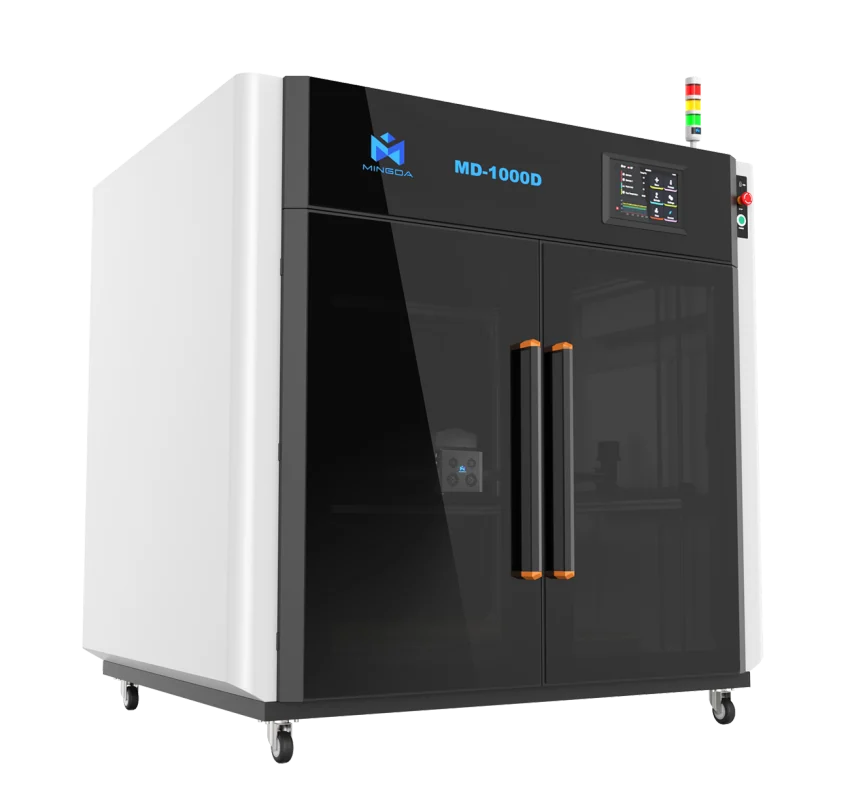
The MINGDA MD-1000D is a large-format industrial 3D printer designed for manufacturing oversized components, engineering prototypes, industrial tooling, molds, and functional parts.
With an impressive build volume of 1000 × 1000 × 1000 mm, the MD-1000D enables the production of large-scale objects in a single printing process, significantly reducing the need for component segmentation, assembly, and additional manufacturing operations.
The printer combines dual-extruder technology, high-temperature printing capabilities, a fully enclosed structure, a closed-loop motion system, and advanced control technologies, making it suitable for demanding engineering and industrial manufacturing environments.
It is particularly valuable for organizations looking to implement large-scale additive manufacturing, develop customized products, manufacture complex components, and improve production flexibility.
The MD-1000D utilizes Fused Deposition Modeling (FDM) technology, in which thermoplastic materials are melted and deposited layer by layer to produce three-dimensional objects from digital CAD models.
Its exceptionally large printing volume of one cubic meter provides the capability to manufacture substantial components, including equipment housings, industrial structures, large prototypes, molds, and functional engineering parts.
The printer features an enclosed industrial chassis, dual extruders, a high-temperature hotend, a heated printing platform, and a precision motion system designed for stability during long-duration printing operations.
The machine is engineered to support both conventional thermoplastics and advanced engineering materials, providing flexibility across a wide range of industrial applications.
The MD-1000D offers a massive build volume of 1000 × 1000 × 1000 mm, allowing users to manufacture large-scale parts and prototypes without dividing them into multiple sections.
This capability is particularly beneficial for producing large industrial components, equipment enclosures, architectural models, automotive prototypes, and customized mechanical structures.
The printer is equipped with two print heads, enabling multi-material and multi-color printing, as well as the use of dedicated support materials.
This configuration allows complex models to be manufactured with improved support strategies, facilitating the production of geometries with overhangs, cavities, and intricate structural features.
The MD-1000D features a hotend capable of reaching temperatures of up to 350°C and a heated build platform capable of reaching 110°C.
These capabilities enable the use of a wide range of thermoplastic materials, including advanced engineering filaments reinforced with carbon fiber and glass fiber.
The printer incorporates precision linear guides, a closed-loop motion control system, and high-performance mechanical components designed to improve stability, accuracy, and reliability during printing.
The closed-loop motor system helps reduce motion errors and supports consistent operation during long printing jobs.
The enclosed structure provides a more controlled printing environment, helping reduce the effects of external temperature fluctuations and airflow on printed components.
This is especially important when manufacturing large parts and working with engineering materials that are more sensitive to environmental conditions.
The automatic leveling system simplifies machine preparation and helps ensure proper first-layer adhesion across the large printing platform.
This feature reduces manual calibration requirements and supports more reliable printing operations.
The MINGDA MD-1000D is designed for large-scale production and rapid prototyping, combining high printing speeds with a large manufacturing capacity.
Its performance features include:
Maximum printing speed of up to 300 mm/s.
Recommended printing speeds depending on the material.
Maximum XY movement speed of up to 500 mm/s.
Maximum acceleration of up to 10,000 mm/s².
Maximum material flow rate of approximately 40 mm³/s.
Closed-loop motion control for improved stability.
Input shaping technology for vibration compensation.
Dual-extruder system for complex printing applications.
The large build volume enables the production of substantial components in a single operation, while the optimized motion system supports efficient manufacturing and shorter development cycles.
The printer is particularly suitable for applications where conventional smaller-format printers would require multiple printing operations and subsequent assembly.
The MD-1000D supports a wide range of thermoplastic materials, from standard filaments to advanced engineering composites.
|
Material |
Typical Applications |
|---|---|
|
PLA |
Prototypes, concept models, large display models |
|
PETG |
Functional components, equipment covers, brackets |
|
PETG-CF |
Reinforced engineering components |
|
PET-CF |
Rigid structural and mechanical parts |
|
PET-GF |
Glass-fiber-reinforced engineering components |
|
PA12-CF |
Strong mechanical and functional components |
|
HTPA-CF |
High-performance engineering parts |
|
HTPA-GF |
Reinforced components requiring strength and rigidity |
|
HTPA-GF25 / CF25 |
Advanced reinforced engineering applications |
|
PPS |
High-temperature and chemical-resistant components |
|
PPS-CF / PPS-GF |
Advanced industrial components |
|
S-Multi / S-HTPA |
Specialized support-material applications |
|
PVA |
Water-soluble support structures, subject to compatibility |
The ability to work with reinforced engineering materials provides opportunities for producing components with enhanced strength, stiffness, dimensional stability, and thermal performance.
Material selection should always be based on the required mechanical properties, operating temperature, environmental conditions, and compatibility with the printer configuration.
The MINGDA MD-1000D is suitable for a broad range of industrial and engineering applications where large-scale manufacturing, customization, and rapid production are required.
Manufacturing selected replacement components for machinery, industrial equipment, production lines, and maintenance systems.
The large build volume allows the production of bigger components that would otherwise require multiple sections and assembly.
The printer can be used for producing large automotive prototypes, interior components, design models, fixtures, customized parts, and selected functional components.
The MD-1000D enables engineers to convert CAD designs into physical prototypes for evaluation, testing, dimensional verification, and design improvement.
The printer can produce customized jigs, fixtures, assembly tools, positioning devices, inspection aids, and manufacturing accessories.
It can manufacture large housings, covers, protective enclosures, panels, and customized structures for industrial equipment.
The printer can be used to produce large-scale models, prototype molds, patterns, and selected tooling components for manufacturing and development processes.
The MD-1000D supports research institutions, engineering departments, and innovation centers by enabling rapid experimentation, product development, and large-scale prototyping.
It provides an efficient solution for manufacturing limited quantities of customized components without requiring expensive traditional tooling or injection molds.
|
Specification |
Description |
|---|---|
|
Manufacturer |
MINGDA |
|
Model |
MD-1000D |
|
Printing Technology |
Fused Deposition Modeling (FDM) |
|
Maximum Build Volume |
1000 × 1000 × 1000 mm |
|
Build Capacity |
1 cubic meter |
|
Extruder Configuration |
Dual Extruders |
|
Filament Diameter |
1.75 mm |
|
Standard Nozzle Diameter |
0.6 mm |
|
Optional Nozzle Diameters |
0.4 mm and 0.8 mm |
|
Maximum Nozzle Temperature |
350°C |
|
Recommended Maximum Temperature |
Approximately 320°C, depending on material |
|
Maximum Build Plate Temperature |
110°C |
|
Maximum Printing Speed |
300 mm/s |
|
Recommended PLA Speed |
200 mm/s |
|
Recommended PETG Speed |
180 mm/s |
|
Recommended PET-CF Speed |
100 mm/s |
|
Maximum XY Movement Speed |
500 mm/s |
|
Maximum Z Movement Speed |
15 mm/s |
|
Maximum Acceleration |
10,000 mm/s² |
|
Maximum Material Flow Rate |
40 mm³/s |
|
Printing Layer Height |
Material and nozzle dependent |
|
Build Platform |
10 mm aluminum plate, magnetic surface, PEI |
|
Leveling System |
Automatic leveling |
|
Motion System |
Closed-loop control system |
|
Linear Motion Components |
Precision linear guides |
|
Printing Chamber |
Fully enclosed |
|
Chamber Temperature |
Up to approximately 45°C, according to product configuration |
|
Display |
10-inch touchscreen |
|
Firmware |
Klipper |
|
Slicing Software |
MINGDA Slicer / compatible slicing software |
|
File Formats |
STL, 3MF, STEP, STP, AMF, OBJ |
|
Connectivity |
Wi-Fi, Ethernet, USB |
|
Remote Monitoring |
Supported |
|
Remote Printing |
Supported |
|
Camera |
Integrated camera |
|
Filament Detection |
Yes |
|
Power Loss Recovery |
Yes |
|
Automatic Self-Check |
Yes |
|
Emergency Stop |
Yes |
|
Safety Indicator |
Three-color warning light |
|
Input Voltage |
220 V, 50/60 Hz, depending on configuration |
|
Rated / Maximum Power |
Approximately 2700–3100 W, depending on revision |
|
Machine Dimensions |
Approximately 1680–1710 × 1365 × 1665 mm |
|
Packaging Dimensions |
Approximately 1980 × 1630 × 1920 mm |
|
Approximate Shipping Weight |
654.5 kg, according to one specification |
|
Packaging Volume |
Approximately 6.2 m³ |
The MD-1000D incorporates a range of smart features designed to simplify operation, improve reliability, and reduce printing failures.
Automatic Bed Leveling: Automatically measures and calibrates the printing platform to improve first-layer accuracy.
Power Loss Recovery: Saves printing progress and supports resuming the printing process following a power interruption.
Filament Detection: Detects filament depletion and pauses printing to prevent failed jobs.
Integrated Camera: Allows users to monitor printing operations.
Remote Printing and Monitoring: Enables network-based printing management and remote monitoring.
Automatic Startup Self-Check: Checks key machine components, including the extruder, heated platform, camera, leveling system, and fans.
Dual-Extruder Calibration: Enables alignment and offset calibration between the two print heads.
Vibration Compensation: Helps improve printing quality and dimensional accuracy at higher speeds.
10-Inch Touchscreen Interface: Provides an intuitive interface for printer configuration, operation, and monitoring.
Emergency Stop and Warning Indicator: Provides safety-related functions for industrial operation.
These features help improve operational efficiency, simplify machine management, and reduce the risk of failed printing jobs during long-duration manufacturing operations.
The MD-1000D can be integrated into a complete digital manufacturing workflow, starting with CAD design and ending with the production of physical components.
The typical workflow includes:
Designing the component using CAD software.
Exporting the model into a compatible 3D file format.
Importing the design into slicing software.
Selecting the appropriate material, nozzle, printing parameters, and support structures.
Generating the G-code file.
Transferring the file through USB or network connectivity.
Starting and monitoring the printing operation.
Inspecting, testing, and finishing the manufactured component.
Compatible engineering software may include SolidWorks, Autodesk Fusion, AutoCAD, and other CAD applications capable of exporting compatible 3D models.
MINGDA's slicing software and compatible slicer applications can be used to prepare large-format printing jobs, configure dual-extruder operations, manage materials, and optimize printing parameters.
Integrating the MINGDA MD-1000D into industrial operations can provide significant operational and strategic benefits.
Enables organizations to manufacture selected components, tools, and customized parts locally, reducing dependence on external suppliers.
Accelerates the production of prototypes, spare parts, engineering tools, and customized components.
Reduces the need for traditional molds and tooling for prototypes, customized components, and limited production batches.
Supports maintenance teams by enabling the production of selected replacement components and customized accessories.
The one-cubic-meter build volume enables manufacturing of large components in a single operation, reducing assembly requirements and simplifying production workflows.
Supports product development, rapid prototyping, design testing, and engineering experimentation.
Provides a foundation for integrating additive manufacturing into modern industrial processes and digital transformation initiatives.
Combines large-scale manufacturing capacity, dual-extruder capabilities, high-speed motion systems, and intelligent monitoring features to improve manufacturing flexibility and productivity.
The MINGDA MD-1000D represents a powerful large-format industrial 3D printing solution designed for modern engineering, manufacturing, and industrial development.
With its massive 1000 × 1000 × 1000 mm build volume, dual-extruder configuration, high-temperature printing capability, compatibility with engineering-grade materials, enclosed structure, closed-loop motion system, and intelligent monitoring features, the printer provides a versatile platform for manufacturing large prototypes, functional components, industrial tools, molds, customized products, and selected spare parts.
Its ability to manufacture large components in a single process provides significant advantages in reducing assembly requirements, shortening manufacturing lead times, improving production flexibility, and supporting local manufacturing capabilities.
The MD-1000D is particularly suitable for organizations seeking to adopt advanced additive manufacturing technologies, strengthen their engineering and maintenance capabilities, reduce dependence on external suppliers for selected components, and accelerate innovation through digital manufacturing.
By integrating this technology into industrial operations, organizations can move toward a more flexible, efficient, and digitally enabled manufacturing environment.