- [email protected]
- 00974-50540047
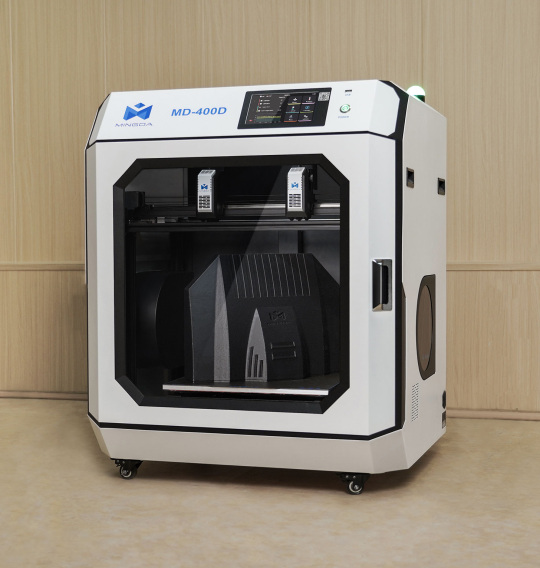
The MINGDA MD-400D+ is an industrial-grade 3D printer designed for digital manufacturing, engineering prototyping, functional part production, and industrial applications. It combines a large build volume, an Independent Dual Extruder (IDEX) system, high printing speeds, and compatibility with a wide range of engineering materials.
The printer is suitable for engineering workshops, manufacturing facilities, research laboratories, innovation centers, and industrial organizations seeking to improve production efficiency and adopt advanced manufacturing technologies.
The MINGDA MD-400D+ is based on Fused Deposition Modeling (FDM) technology, also known as Fused Filament Fabrication (FFF). It produces three-dimensional objects by depositing thermoplastic material layer by layer according to a digital model.
Its enclosed industrial design and 400 × 400 × 400 mm build volume allow users to manufacture relatively large parts in a single printing process, reducing the need for dividing components into multiple sections and assembling them afterward.
The printer's independent dual-extruder system enables multi-material printing, dual-color printing, and the use of specialized support materials. It also supports duplication and mirror printing modes, increasing productivity when manufacturing identical or symmetrical components.
The printer offers a build volume of 400 × 400 × 400 mm, allowing the production of large prototypes, engineering components, housings, fixtures, and functional parts in a single printing operation.
The IDEX system features two independently operating print heads, enabling the printer to work with different materials or colors simultaneously. It also allows the use of dedicated support materials for complex geometries.
The printer supports duplication mode, allowing two identical parts to be manufactured simultaneously, as well as mirror mode for producing symmetrical components. These capabilities improve production efficiency and reduce manufacturing time.
With a maximum nozzle temperature of up to 350°C, the printer supports a variety of engineering-grade thermoplastic materials, including materials requiring higher processing temperatures.
The machine is designed for high-speed printing with advanced motion control, vibration compensation, and optimized extrusion performance, helping maintain print quality while reducing production time.
The MINGDA MD-400D+ incorporates an advanced motion system and electronic control technologies designed to improve printing speed, accuracy, and reliability.
Key performance characteristics include:
Maximum printing speed of up to 300 mm/s.
Maximum travel speed of up to 500 mm/s.
Maximum acceleration of up to 10,000 mm/s².
Maximum material flow rate of approximately 40 mm³/s.
Advanced cooling system for improved layer quality.
Linear motion components for increased stability and precision.
Vibration compensation technology for improved printing quality at higher speeds.
These features make the printer suitable for rapid prototyping, small-batch production, functional engineering parts, and manufacturing applications requiring shorter production cycles.
The MD-400D+ supports a wide range of thermoplastic materials, including standard filaments and advanced engineering materials.
|
Material |
Typical Applications |
|---|---|
|
PLA |
Prototypes, educational models, concept designs |
|
PETG |
Functional parts, brackets, protective components |
|
TPU |
Flexible components, seals, rubber-like parts |
|
ABS |
Industrial components and heat-resistant parts |
|
PA / Nylon |
Mechanical parts requiring strength and durability |
|
PET-CF |
Carbon-fiber-reinforced engineering components |
|
PA-CF / PA-GF |
High-strength mechanical parts |
|
PPS / PPS-CF |
Advanced industrial applications requiring thermal and chemical resistance |
The printer can also support specialized support materials, such as PVA and other compatible materials, depending on the selected configuration and printing requirements.
Material compatibility depends on the required temperature settings, drying conditions, nozzle configuration, and manufacturer recommendations.
The MINGDA MD-400D+ can be used in various industrial and engineering fields, including:
Rapid Prototyping: Producing prototypes for product development and design validation.
Spare Parts Manufacturing: Manufacturing replacement plastic components and parts that may be unavailable in the market.
Jigs and Fixtures: Producing assembly tools, positioning fixtures, inspection aids, and manufacturing accessories.
Mechanical Engineering: Manufacturing brackets, housings, enclosures, machine components, and customized mechanical parts.
Research and Development: Supporting innovation and product development through rapid production of physical models.
Technical Education and Training: Providing practical training in CAD design, 3D modeling, and digital manufacturing.
Small-Batch Production: Manufacturing limited quantities of customized products without the need for traditional tooling or molds.
|
Specification |
Description |
|---|---|
|
Manufacturer |
MINGDA |
|
Model |
MD-400D+ |
|
Printing Technology |
FDM / FFF |
|
Build Volume |
400 × 400 × 400 mm |
|
Printing System |
Independent Dual Extruder (IDEX) |
|
Duplication Mode |
Simultaneous printing of two identical parts |
|
Mirror Mode |
Simultaneous printing of mirrored parts |
|
Filament Diameter |
1.75 mm |
|
Standard Nozzle Diameter |
0.4 mm |
|
Optional Nozzle Sizes |
0.6 mm and 0.8 mm |
|
Maximum Printing Speed |
300 mm/s |
|
Maximum Travel Speed |
500 mm/s |
|
Maximum Nozzle Temperature |
350°C |
|
Maximum Build Plate Temperature |
110°C |
|
Maximum Material Flow Rate |
40 mm³/s |
|
Control System |
Klipper / MINGDA Pi |
|
Display |
7-inch touchscreen |
|
Connectivity |
Wi-Fi, Ethernet, USB |
|
Maximum Power Consumption |
Approximately 800 W |
|
Build Platform |
Aluminum platform with PEI surface |
|
Bed Leveling |
Automatic leveling |
|
Printer Structure |
Enclosed industrial design |
|
Approximate Dimensions |
758 × 660 × 911 mm |
|
Shipping Weight |
Approximately 126 kg, depending on configuration |
The printer incorporates several intelligent functions designed to simplify operation and improve reliability:
Automatic bed leveling for improved first-layer accuracy.
Power-loss recovery to resume printing after power interruptions, subject to operating conditions.
Filament detection to help prevent printing failures caused by material depletion.
Dual-extruder calibration for accurate alignment between print heads.
Input shaping and vibration compensation to improve print quality at higher speeds.
Network connectivity for remote monitoring and control, depending on the system configuration.
Touchscreen interface for convenient operation and print management.
These features help reduce operator intervention, improve printing consistency, and minimize material waste caused by failed printing jobs.
The MINGDA MD-400D+ operates within a digital manufacturing workflow that begins with a 3D CAD model and ends with a physical manufactured component.
The workflow typically includes:
Designing the component using CAD software.
Exporting the model into a compatible 3D file format.
Preparing the model using slicing software.
Configuring printing parameters, materials, supports, and print modes.
Transferring the print file to the printer.
Executing and monitoring the printing process.
Inspecting and finishing the manufactured component.
Commonly used design software includes SolidWorks, Autodesk Fusion, AutoCAD, and other CAD applications capable of generating compatible 3D models.
Supported file formats may include STL, 3MF, OBJ, AMF, and other formats compatible with the selected slicing software.
Acquiring an industrial 3D printer such as the MINGDA MD-400D+ provides organizations with an opportunity to integrate digital manufacturing into their engineering and maintenance operations.
Key benefits include:
Reducing dependence on external suppliers for certain plastic components.
Accelerating engineering development and prototype production.
Reducing waiting times for customized parts and manufacturing tools.
Supporting maintenance operations through local production of selected replacement components.
Improving productivity in engineering and research departments.
Reducing the cost of producing small batches and customized components.
Increasing manufacturing flexibility through dual-extruder printing capabilities.
Supporting digital transformation and innovation in industrial production.
The MINGDA MD-400D+ represents a powerful platform for industrial 3D printing and digital manufacturing. Its large build volume, independent dual-extruder system, high-speed printing capabilities, engineering material compatibility, and intelligent control features make it a versatile solution for modern manufacturing and engineering environments.
The printer provides organizations with the ability to produce prototypes, functional components, customized tools, fixtures, and selected spare parts efficiently and locally. By integrating this technology into engineering, maintenance, and research workflows, organizations can improve productivity, reduce manufacturing lead times, support innovation, and strengthen their capabilities in advanced digital manufacturing.