- [email protected]
- 00974-50540047
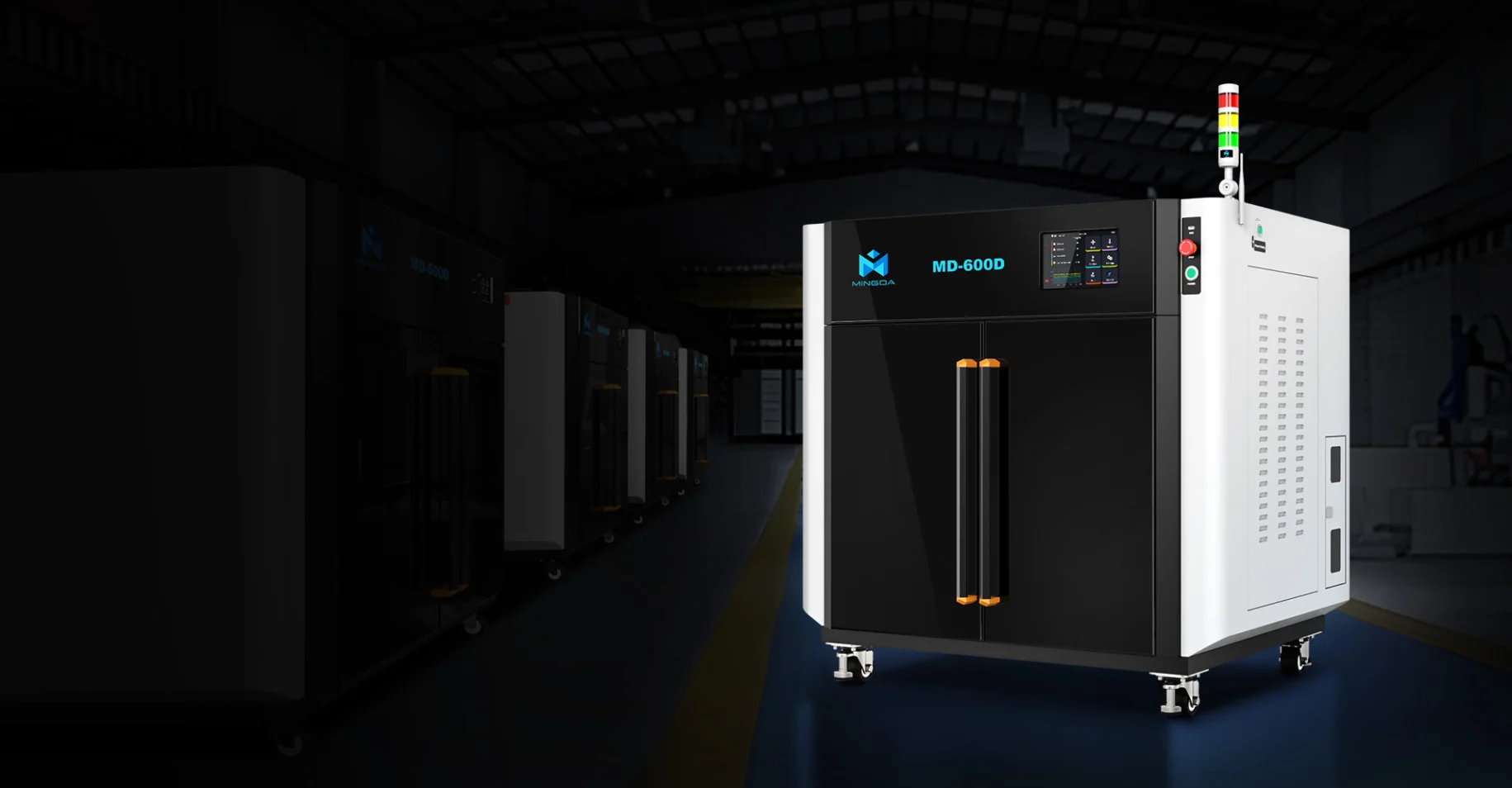
The MINGDA MD-600D is a professional large-format 3D printer designed for industrial manufacturing, engineering applications, functional prototyping, and the production of large and complex components.
Featuring a 600 × 600 × 600 mm build volume, a dual-extruder system, high-temperature printing capabilities, and advanced motion control technology, the MD-600D provides an effective solution for organizations seeking to integrate additive manufacturing into their production, maintenance, and engineering workflows.
Its large printing capacity allows the manufacturing of substantial components in a single process, reducing the need for assembly, improving design flexibility, and shortening production lead times.
The MD-600D uses Fused Deposition Modeling (FDM) technology, in which thermoplastic materials are heated and deposited layer by layer to create three-dimensional objects from digital designs.
The printer is equipped with a large enclosed build chamber and a dual-extruder configuration, enabling the production of complex models, functional parts, engineering prototypes, and components requiring support materials.
Its industrial design is intended to support long-duration printing operations while maintaining consistent performance, stability, and printing quality.
The machine is particularly suitable for applications involving large mechanical parts, equipment housings, industrial fixtures, prototypes, and customized manufacturing components.
The MD-600D offers a build volume of 600 × 600 × 600 mm, allowing users to manufacture large components in a single printing process. This capacity is particularly useful for industrial housings, mechanical structures, prototypes, and customized equipment parts.
The dual-extruder configuration enables printing with two materials or colors and allows the use of dedicated support materials for complex structures. This improves design flexibility and facilitates the manufacturing of parts with overhangs, internal structures, and complex geometries.
The printer supports nozzle temperatures of up to 350°C and build plate temperatures of up to 110°C, making it suitable for a range of standard and engineering-grade thermoplastic materials.
The MD-600D incorporates advanced motion control and vibration compensation technologies to improve printing performance and reduce production time. Its motion system supports high-speed operation while maintaining stability and accuracy.
The enclosed design helps provide a controlled printing environment and supports the production of larger components and engineering materials that may be sensitive to environmental conditions.
The automatic bed-leveling system simplifies setup and helps achieve a consistent first layer, reducing manual calibration requirements and improving printing reliability.
The MINGDA MD-600D is designed to support efficient manufacturing operations through a combination of large printing capacity, dual extrusion, and optimized printing speeds.
Its performance characteristics include:
Maximum printing speed of up to 300 mm/s.
Recommended printing speeds depending on the material and application.
Maximum travel speed of up to 500 mm/s.
Maximum acceleration of up to 10,000 mm/s².
Maximum material flow rate of approximately 40 mm³/s.
Vibration compensation technology for improved print quality.
Advanced cooling system for optimized material deposition.
Dual-extruder operation for multi-material and support-material printing.
These capabilities make the MD-600D suitable for producing large prototypes, industrial components, customized parts, and small production batches with reduced manufacturing lead times.
The MD-600D supports a variety of thermoplastic materials, including conventional filaments, engineering materials, and specialized support materials.
|
Material |
Typical Applications |
|---|---|
|
PLA |
Prototypes, models, educational applications |
|
PETG |
Functional parts, brackets, enclosures |
|
TPU |
Flexible components and protective parts |
|
PET-CF / PET-GF |
Reinforced structural and engineering parts |
|
PA-CF / PA-GF |
Durable mechanical components |
|
HTPA-CF / HTPA-GF |
High-performance engineering applications |
|
ABS-CF / ABS-GF |
Industrial components and reinforced parts |
|
PPS |
High-temperature and chemical-resistant applications |
|
PPS-CF / PPS-GF |
Advanced industrial components |
|
PVA and specialized support materials |
Complex structures and removable supports |
The availability of engineering materials makes the MD-600D suitable for manufacturing components requiring enhanced mechanical strength, rigidity, temperature resistance, and durability.
Material selection should be based on the specific mechanical, thermal, chemical, and environmental requirements of the intended application.
The MINGDA MD-600D can be used across a wide range of industrial, technical, and engineering applications.
Manufacturing replacement components for selected machinery, equipment, and industrial systems, particularly plastic parts that are difficult to source or require customization.
Producing mechanical components, brackets, housings, covers, adapters, mounting structures, and customized parts for engineering applications.
Transforming CAD designs into physical prototypes for design evaluation, testing, dimensional verification, and product development.
Producing jigs, fixtures, assembly aids, positioning tools, and inspection accessories to support manufacturing processes.
Manufacturing large enclosures, protective covers, equipment panels, and customized structural components.
Supporting engineering teams, laboratories, and innovation centers by enabling faster experimentation, prototype development, and customized manufacturing.
Producing limited quantities of customized components without requiring traditional molds or expensive tooling.
|
Specification |
Description |
|---|---|
|
Manufacturer |
MINGDA |
|
Model |
MD-600D |
|
Printing Technology |
Fused Deposition Modeling (FDM) |
|
Build Volume |
600 × 600 × 600 mm |
|
Machine Dimensions |
Approximately 1300 × 965 × 1255 mm |
|
Extruder Configuration |
Dual Extruders |
|
Filament Diameter |
1.75 mm |
|
Standard Nozzle Diameter |
0.6 mm |
|
Optional Nozzle Sizes |
0.4 mm, 0.8 mm |
|
Maximum Nozzle Temperature |
350°C |
|
Maximum Build Plate Temperature |
110°C |
|
Maximum Printing Speed |
Up to 300 mm/s |
|
Recommended Printing Speed |
Material-dependent |
|
Maximum Travel Speed |
Up to 500 mm/s |
|
Maximum Acceleration |
Up to 10,000 mm/s² |
|
Maximum Material Flow Rate |
40 mm³/s |
|
Build Platform |
Aluminum platform with PEI surface |
|
Bed Leveling |
Automatic leveling |
|
Display |
10-inch touchscreen |
|
Connectivity |
Wi-Fi, Ethernet, USB |
|
Firmware |
Klipper |
|
Printing File Format |
G-code |
|
Supported File Formats |
STL, 3MF, STEP, OBJ, AMF and compatible formats |
|
Power Supply |
AC power |
|
Rated / Maximum Power |
Approximately 2000–2400 W, depending on specification/configuration |
|
Chamber |
Enclosed printing chamber |
|
Camera |
Integrated camera |
|
Filament Detection |
Yes |
|
Power Loss Recovery |
Yes |
|
Remote Monitoring |
Network monitoring and control support |
|
Operating System Compatibility |
Windows and macOS through compatible slicing software |
The MD-600D incorporates several intelligent functions designed to simplify operation and improve manufacturing reliability.
Automatic Bed Leveling: Automatically calibrates the printing platform to improve first-layer accuracy.
Power Loss Recovery: Supports recovery and continuation of printing after power interruptions.
Filament Detection: Detects filament depletion and pauses printing to help prevent failed jobs.
Integrated Camera: Enables monitoring of printing operations.
Remote Monitoring and Control: Supports network-based monitoring and printing management.
Self-Check System: Performs system checks to help identify potential issues during startup.
Vibration Compensation: Helps improve print quality during higher-speed operations.
Touchscreen Interface: Provides an accessible interface for printer operation, configuration, and monitoring.
Dual-Extruder Calibration: Supports calibration of the two print heads to improve alignment and printing accuracy.
These features help improve operational efficiency, reduce material waste, and simplify printer management.
The MD-600D can be integrated into a modern digital manufacturing workflow using CAD design software and slicing applications.
The typical workflow includes:
Designing the component using CAD software.
Exporting the design into a compatible 3D file format.
Importing the model into slicing software.
Selecting the appropriate material and printing parameters.
Generating the G-code file.
Transferring the file to the printer through USB or network connectivity.
Starting and monitoring the printing process.
Inspecting and finishing the manufactured component.
Compatible design applications may include SolidWorks, Autodesk Fusion, AutoCAD, and other engineering software capable of generating compatible 3D models.
Slicing software such as MINGDA's compatible slicer, OrcaSlicer-based workflows, and other supported applications can be used to prepare printing jobs, depending on the printer firmware and software configuration.
Integrating the MD-600D into industrial operations can provide several operational and strategic benefits:
Local Manufacturing: Enables the production of selected components on-site, reducing reliance on external suppliers.
Reduced Lead Times: Produces prototypes, tools, and replacement parts more rapidly.
Cost Optimization: Reduces the need for traditional tooling and molds for prototypes and limited production runs.
Maintenance Support: Helps maintenance teams manufacture customized replacement parts and equipment accessories.
Engineering Flexibility: Enables rapid modification and production of customized designs.
Large-Scale Prototyping: Supports the production of larger components without dividing them into multiple sections.
Improved Productivity: Dual-extruder capabilities support complex structures and specialized support materials.
Innovation and Development: Strengthens research, development, and engineering capabilities.
Digital Manufacturing Integration: Supports the adoption of modern manufacturing technologies and digital production workflows.
The MINGDA MD-600D is a professional large-format industrial 3D printer designed to meet the requirements of modern engineering, manufacturing, and industrial development.
Its 600 × 600 × 600 mm build volume, dual-extruder configuration, high-temperature printing capabilities, compatibility with engineering materials, automatic calibration systems, and intelligent monitoring features make it a versatile solution for producing large prototypes, functional components, manufacturing tools, customized parts, and selected industrial spare parts.
By integrating the MD-600D into engineering and manufacturing operations, organizations can improve production flexibility, reduce manufacturing lead times, support maintenance activities, optimize costs for selected applications, and accelerate innovation through digital manufacturing.
The printer represents an important step toward adopting advanced manufacturing technologies and establishing more flexible, efficient, and locally supported production capabilities.